Work Hours Calculator
How to Calculate Overnight and Night Shift Hours
The add-24-hours trick, workweek rules, daylight saving changes, and night pay.
Read the guideFree time card tools and payroll guides
Enter clock in and clock out times, subtract unpaid breaks, and see your total in hh:mm and decimal hours. Then apply weekly or daily overtime and estimate gross pay. Short guides explain every number.
A work hours calculator turns clock in and clock out times into a total you can check. It subtracts unpaid breaks, handles shifts that cross midnight, and shows the result as hours and minutes and as decimal hours. Payroll software usually wants the decimal version.
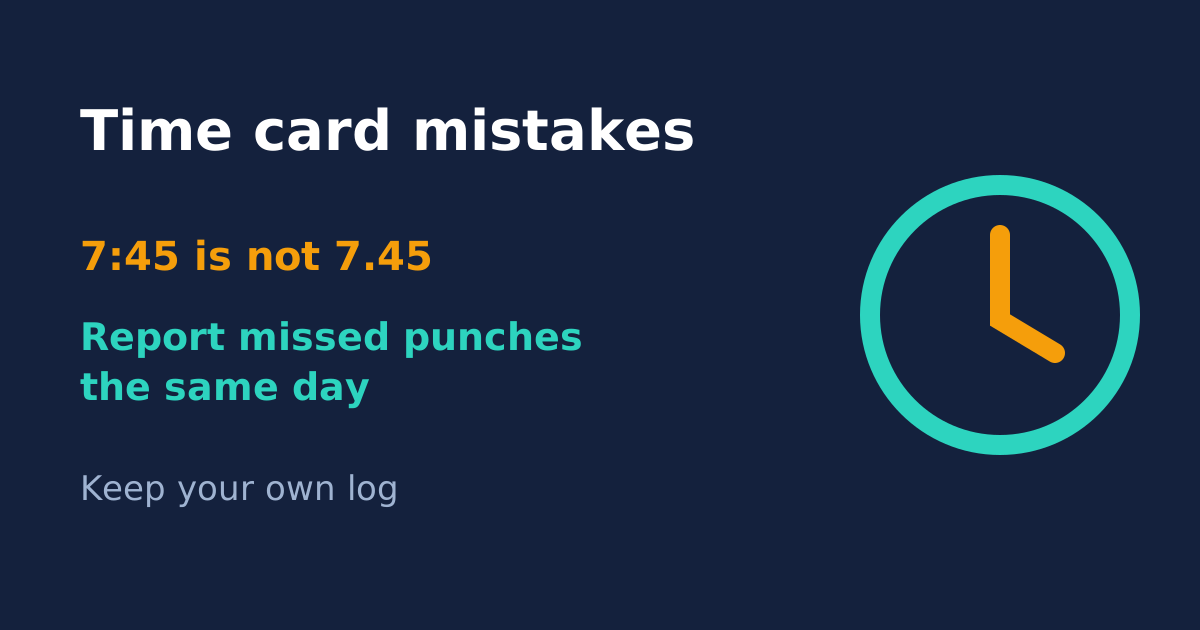
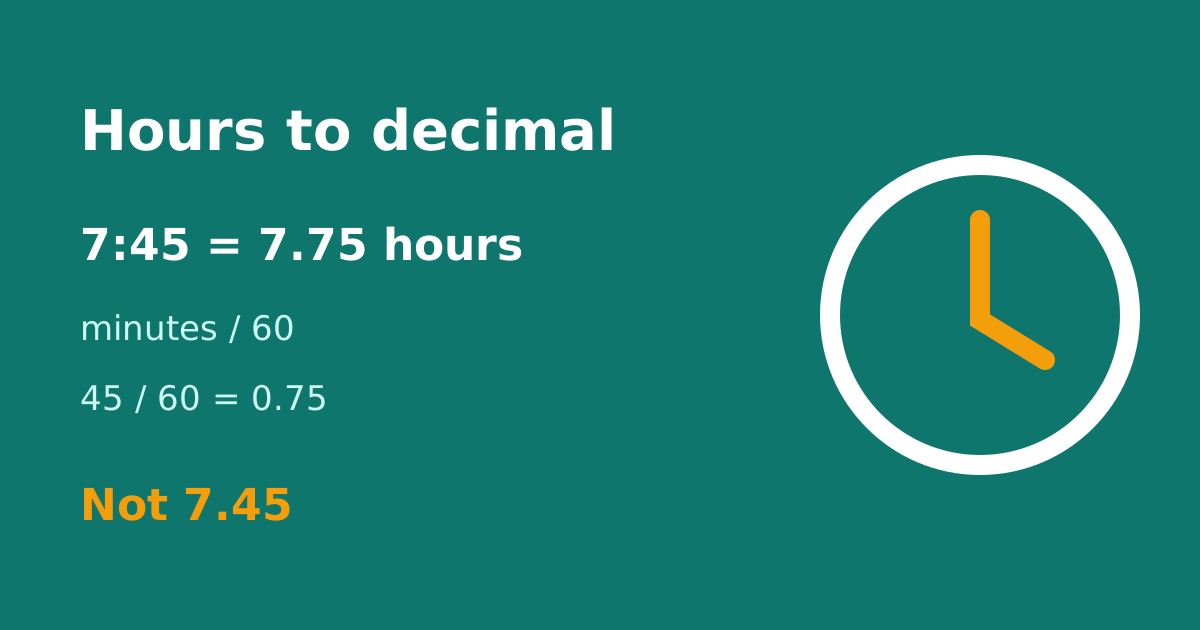
Small errors add up fast. A missed lunch deduction, a 7:45 typed as 7.45, or an overtime hour counted twice can change a paycheck. Run your timesheet through the calculator first. Then read the guides to see why each number lands where it does.
These are the situations that make hand-counting hours go wrong. Each feature links to a guide that explains the rule behind it.
Enter unpaid break minutes for each day. You can also set an automatic lunch that applies only to long shifts.
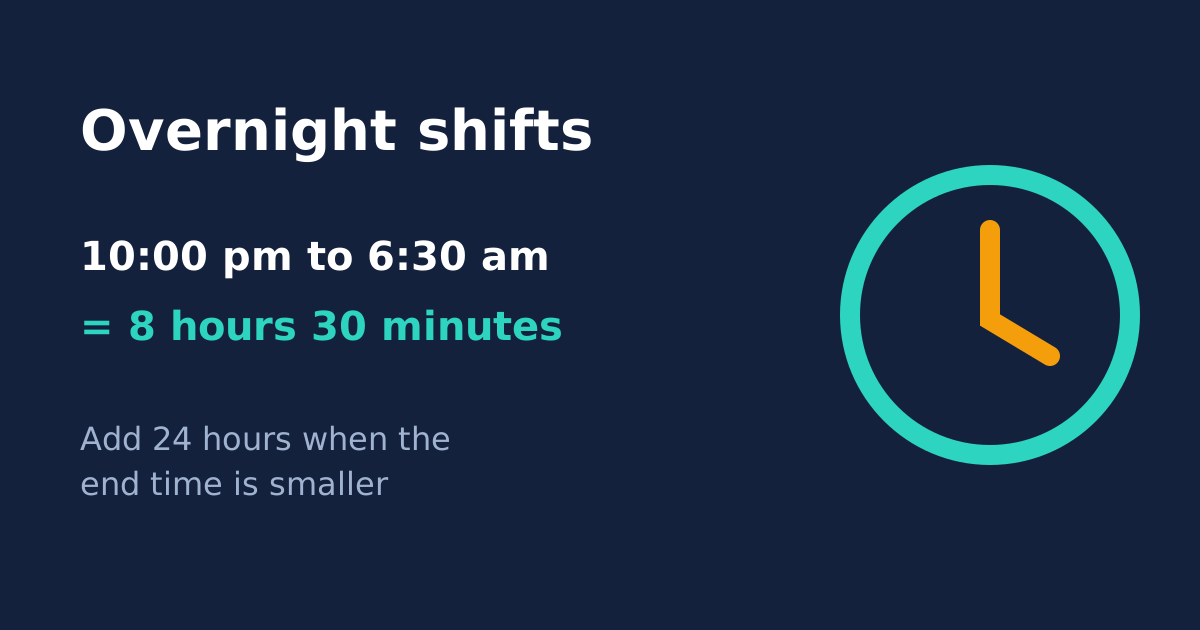
Breaks guideIf the end time comes before the start time, the calculator adds a day for you. A 10 pm to 6 am shift counts as 8 hours.
Night shift guidePick weekly, daily, or both. Each hour is counted once, so no hour is paid twice.
Overtime rulesEvery total shows as hh:mm and as decimal hours. The decimal version is ready to multiply by a pay rate.
Decimal guideRound punches to the nearest 5, 6, or 15 minutes. That way the total matches your employer's timeclock.
7 minute ruleAdd an hourly rate to see gross pay. Set a weekly target, then copy, print, or download a CSV.
Pay guideAdd a start and end time for each day you worked.
Add unpaid minutes. Then pick weekly, daily, or no overtime.
See hh:mm, decimal hours, overtime, and pay. Copy, print, or export.
This is the week behind the sample card at the top of the page. Every shift starts at 8:00 am and includes a 30 minute unpaid lunch.
| Day | Clock out | Unpaid break | Paid time |
|---|---|---|---|
| Monday | 4:45 pm | 30 min | 8:15 |
| Tuesday | 4:30 pm | 30 min | 8:00 |
| Wednesday | 5:00 pm | 30 min | 8:30 |
| Thursday | 4:30 pm | 30 min | 8:00 |
| Friday | 5:00 pm | 30 min | 8:30 |
| Weekly total | 41:15 (41.25 hours) | ||
The first 40:00 count as regular time. The last 1:15 is overtime. At $20 an hour, that is $800.00 in regular pay plus $37.50 in overtime pay.
You do not need a tool for every check. These three calculations sit behind most time card questions.
End time − start time − unpaid break. For 9:00 am to 5:30 pm with a 30 minute lunch, that is 8 hours. Full walkthrough
Whole hours + minutes ÷ 60. Seven hours 45 minutes is 7 + 45/60, which is 7.75 hours. See the chart
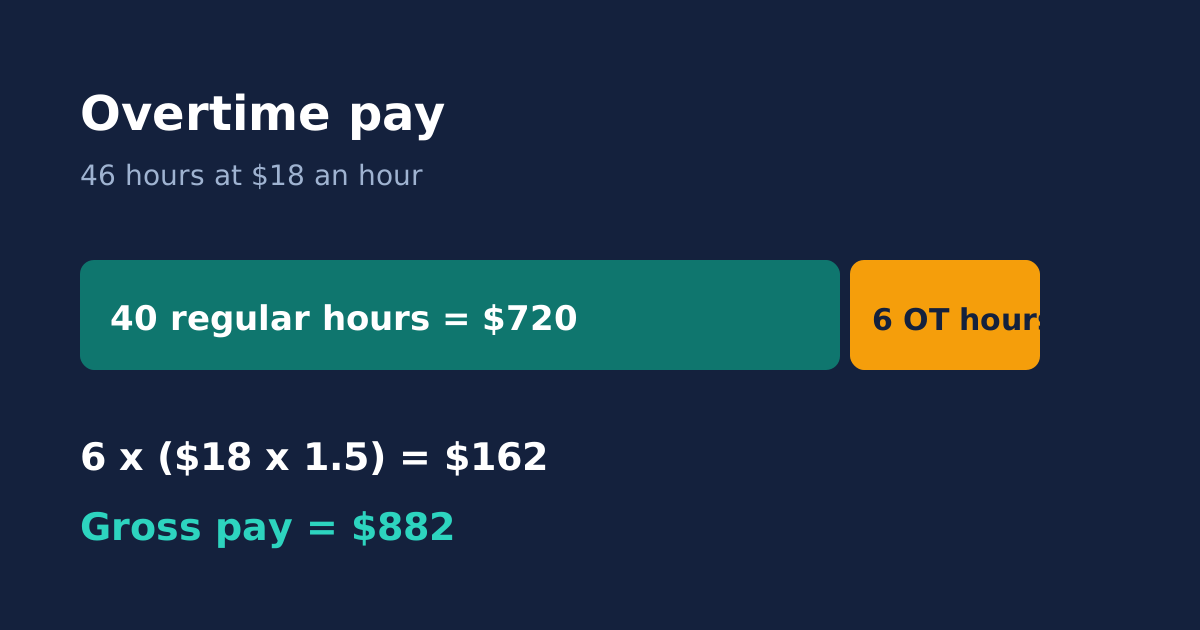
Overtime hours × rate × 1.5. Federal overtime applies after 40 hours in a workweek for most non-exempt employees. Read the guide
| Minutes | 6 | 10 | 15 | 20 | 30 | 45 |
|---|---|---|---|---|---|---|
| Decimal hours | 0.10 | 0.17 | 0.25 | 0.33 | 0.50 | 0.75 |
Hours are not always a simple subtraction. These six rules explain most of the gaps between a worker's count and a pay stub.
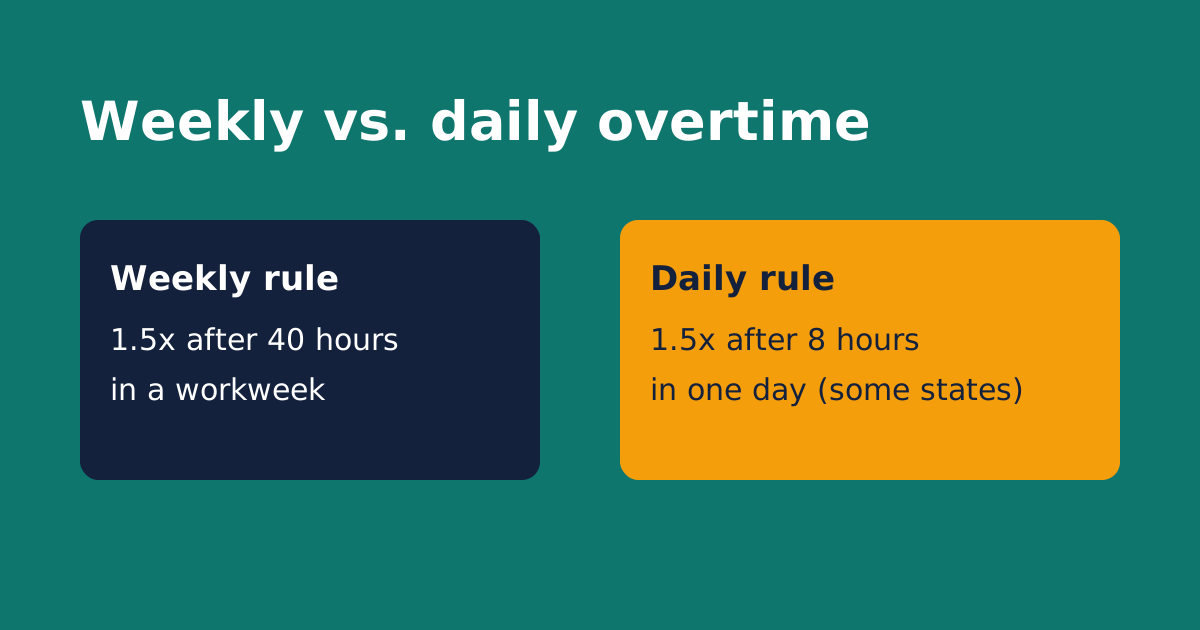
Federal law defines a workweek as a fixed 168 hours, or seven straight 24 hour days. Your employer picks the start day. Hours cannot be averaged across two weeks.
Most states follow the federal weekly rule alone. A few, including California and Alaska, also pay overtime after 8 hours in one day. Compare the rules
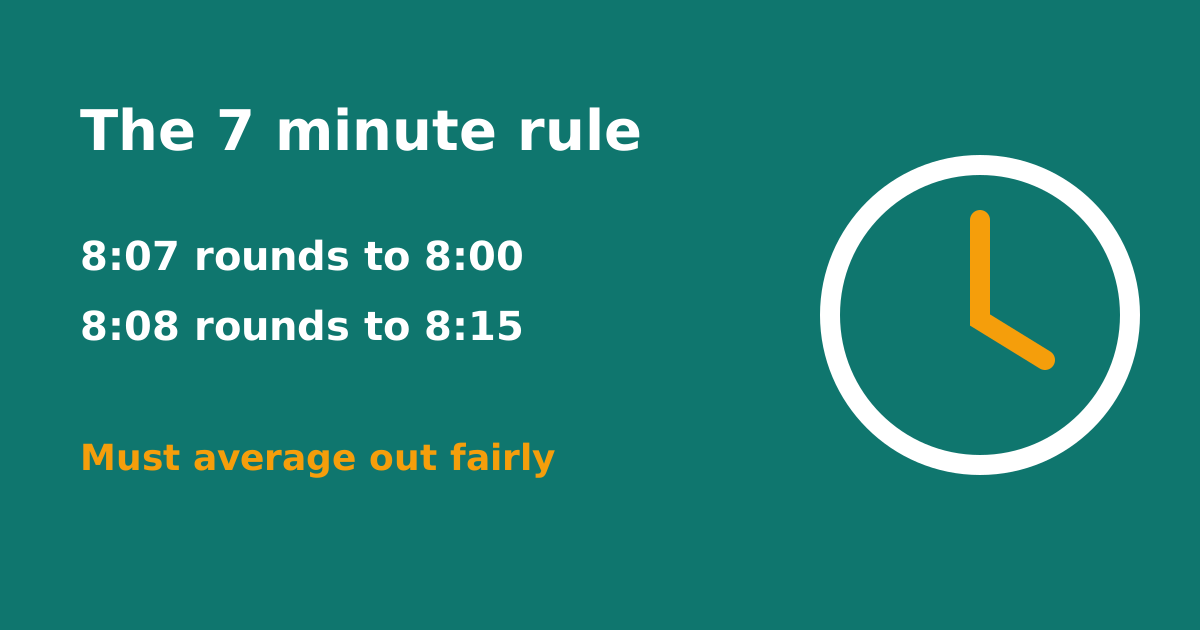
Under the 7 minute rule, 1 to 7 minutes round down and 8 to 14 minutes round up to the nearest quarter hour. The method must even out fairly over time. See how it works
Short rest breaks of 5 to 20 minutes are paid. A meal period of 30 minutes or more can be unpaid if you are fully relieved of duty. Read the guide
Exempt workers do not earn overtime. Job duties and salary level decide who is exempt. A job title alone does not.
Employers must keep time cards for 2 years and payroll records for 3 years. Keep your own copy as well, so you can compare it with your pay stub.
Check that your pay stub matches the hours you really worked. Look at breaks, rounding, and overtime first.
Total your billable time for the week. Convert it to decimal hours for invoices.
Review a time card before payroll closes. Part-time, shift, and overnight schedules all work the same way.
The guides sit in three groups. Start with the one that matches what you need to fix.
The add-24-hours trick, workweek rules, daylight saving changes, and night pay.
Read the guideThe errors that cost workers money, what each one costs, and how to get a correction.
Read the guideHow quarter hour rounding works, when it is fair, and how to check your own time card.
Read the guideThe formula, the regular rate, bonus and two-rate examples, and state rules.
Read the guideHow each rule works, which states use daily limits, and how to avoid counting an hour twice.
Read the guideA simple formula, a quick chart, and the mistakes that cost workers money.
Read the guideYes. There is no sign-up, no paywall, and no limit on how many weeks you can total. Open the calculator, enter your times, and read the result.
No. Your entries are saved in your own browser so they are there when you come back. Nothing you type is sent to a server, and clearing your browser data removes it.
The math is exact for the times and rules you enter. That covers hours and minutes, decimal hours, and weekly or daily overtime. It is still an estimate, because your employer may round punches, pay differentials, or follow state rules the tool cannot see. Compare it with your pay stub.
Most employers treat 40 hours a week as full time, which adds up to 2,080 hours in a year. Federal wage law does not set a full-time number. The Affordable Care Act does, and it counts 30 hours a week as full time for employer health coverage.
Yes. Total your billable time, switch to decimal hours, and multiply by your rate. Independent contractors do not earn overtime under federal wage law, so set overtime to none.
Yes. The calculator and every guide work on phones, tablets, and desktops. You can also print or copy a summary of your week.
Muhammad Haseeb Khan writes and reviews each guide using the sources linked at the end, as described on the editorial policy page. The guides are general information, not legal or payroll advice, so check your state labor department for rules that apply to you.
It takes under a minute, and your times never leave your browser.
Open the Work Hours CalculatorResults and guides are general information and estimates, not legal or payroll advice. Check your pay stub and your state labor department for rules that apply to you. How we write and review.