 Work Hours Calculator
How to Calculate Overnight and Night Shift Hours
The add-24-hours trick, workweek rules, daylight saving changes, and night pay. Published September 12, 2026. Updated October 23, 2026.
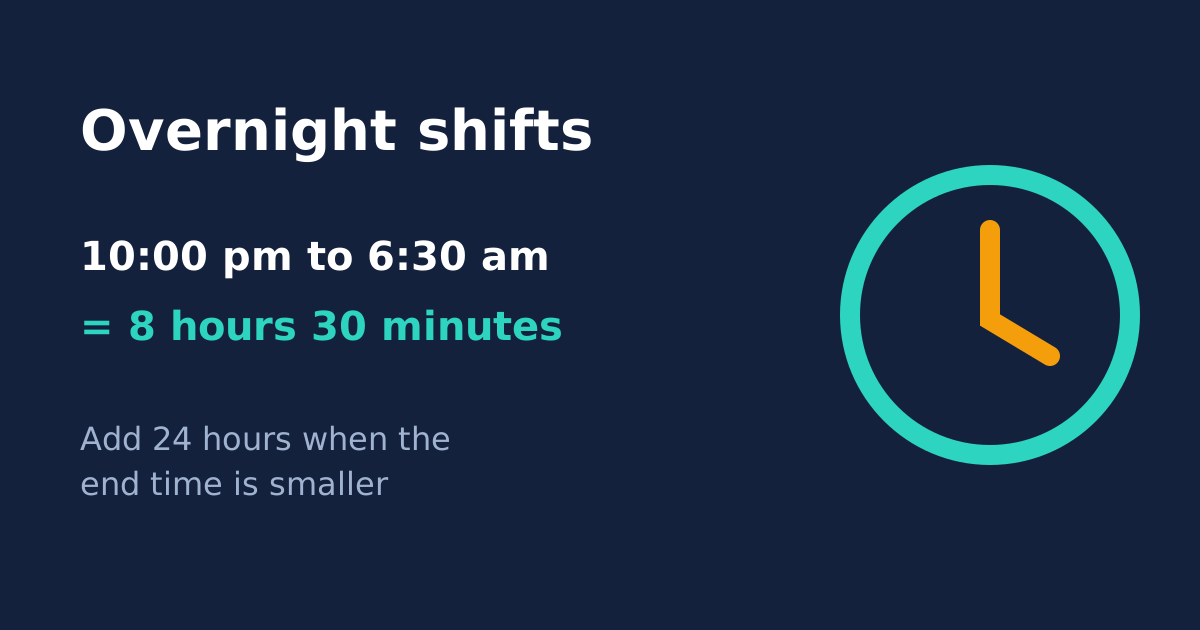
Overnight shift hours are easy once you know one trick. When a shift ends after midnight, add 24 hours to the end time before you subtract. A 10:00 pm to 6:30 am shift becomes 22:00 to 30:30, which is 8 hours 30 minutes. The trick works for any night shift, from a short 4 hour stint to a 12 hour hospital rotation.
The harder questions come later. Which workweek owns the hours? What happens when the clocks change? How does a night differential affect overtime? This guide answers each one. You can test any shift in the Work Hours Calculator.
Why Midnight Breaks the Math
Subtract 10:00 pm from 6:30 am the usual way, and you get a negative number. The clock resets at midnight, but your shift keeps going. Adding 24 hours puts both times on one line again.
- Convert both times to the 24-hour clock.
- If the end time is smaller than the start time, add 24 to the end hour.
- Subtract the start from the end.
- Subtract unpaid break minutes.
Worked Examples
A 7:00 pm to 7:00 am shift reads 19:00 to 31:00, which is 12 hours. Subtract 60 minutes of unpaid breaks, and you have 11 paid hours. An 11:30 pm to 8:00 am shift reads 23:30 to 32:00, or 8 hours 30 minutes. A 30 minute meal break leaves 8 hours.
Short shifts work the same way. A 9:45 pm to 2:15 am shift runs from 21:45 to 26:15, or 4 hours 30 minutes. That is 4.50 decimal hours. The decimal hours guide covers that last step.
A Sample Week of Night Shifts
These five shifts each start on the evening of the day listed.
| Day started | Start | End (next day) | Break | Paid hours |
|---|---|---|---|---|
| Sun | 10:00 pm | 6:30 am | 30 min | 8:00 |
| Mon | 10:00 pm | 6:30 am | 30 min | 8:00 |
| Tue | 10:00 pm | 6:45 am | 30 min | 8:15 |
| Wed | 10:00 pm | 6:30 am | 30 min | 8:00 |
| Thu | 10:00 pm | 7:00 am | 30 min | 8:30 |
The week totals 40 hours 45 minutes, or 40.75 hours. That leaves 0.75 hours of overtime. At $20 an hour, regular pay is $800 and overtime is 0.75 x $30, or $22.50. Gross pay is $822.50.
Which Workweek Owns the Hours
Federal law counts hours in the workweek when you actually work them. Trouble starts when a shift crosses the line between two workweeks. Say the workweek starts at 12:00 am Monday, and you work Sunday 10:00 pm to Monday 6:00 am. Two hours fall in the old week, and six fall in the new one. Each week is tested for overtime on its own. The weekly vs. daily overtime guide defines the workweek in full.
Many employers avoid the split by starting the workweek at shift change, such as Sunday at 6:00 am. Ask payroll where yours starts. The answer tells you which week to use when you check overtime.
Daylight Saving Time
Clock changes alter how long a night shift really lasts. Daylight saving time starts on the second Sunday in March, when clocks jump from 2:00 am to 3:00 am. A 10:00 pm to 6:00 am shift that night lasts only 7 hours. It ends on the first Sunday in November, when clocks fall back from 2:00 am to 1:00 am. The same shift then lasts 9 hours.
Federal law requires pay for hours actually worked. That means 7 hours in spring and 9 in fall, unless your employer pays the scheduled 8 by policy. Calculators that work from clock times, including mine, miss the change. Subtract an hour in spring and add one in fall by hand.
Night Shift Differentials
A night differential is extra hourly pay for late work. The FLSA does not require it. Employers set it by policy or contract, so check your offer letter or union agreement.
The differential matters for overtime, because it belongs in the regular rate. Imagine a $24 base wage with a $3 differential. Your regular rate is $27. Four 12 hour night shifts add up to 48 hours. The first 40 hours pay $1,080. The 8 overtime hours pay $40.50 each, or $324. Gross pay is $1,404. Using the base wage alone gives $1,248, which is $156 too low. The overtime pay guide explains the regular rate.
Breaks After Midnight
Break rules do not change at midnight. Night workers often eat at their post because few places are open. If you stay on duty, the meal period counts as paid time. State rules can differ for healthcare, security, and transport, so see the breaks guide and your state labor site.
Rotating Schedules and 12 Hour Patterns
Enter each shift as its own row. A Tuesday day shift and a Wednesday night shift are two separate entries. Check that one shift does not overlap the next.
Hospitals and plants often run a 2-2-3 pattern of 12 hour shifts. A worker logs two shifts, rests two days, logs three, then rests two more. Over 14 days that is 7 shifts, or 84 hours. Weeks swing between 48 hours and 36 hours. Federal overtime counts each week alone, so the 48 hour week earns 8 overtime hours. The 36 hour week does not cancel them.
Quick Reference for Common Night Shifts
This table shows paid time after one 30 minute unpaid meal period.
| Shift | Time on site | Paid time |
|---|---|---|
| 6:00 pm to 6:00 am | 12:00 | 11:30 |
| 7:00 pm to 7:00 am | 12:00 | 11:30 |
| 10:00 pm to 6:00 am | 8:00 | 7:30 |
| 11:00 pm to 7:00 am | 8:00 | 7:30 |
| 12:00 am to 8:00 am | 8:00 | 7:30 |
An 8 hour night shift with an unpaid meal leaves 7.5 paid hours. Many employers schedule 8.5 hours on site to pay a full 8. Over five shifts, the two setups differ by 2.5 hours.
How to Check a Night Shift Pay Stub
Match each shift to a line on the stub, and confirm it landed in the right week. Look for the night differential, either as its own line or inside a higher rate. Then check that overtime uses the regular rate, differential included. For a clock-change week, confirm the stub shows 7 or 9 hours and not the scheduled 8. If a number is off, send payroll your own log with the date each shift began.
Common Mistakes
- Subtracting without adding 24 hours first.
- Flipping 12:00 am and 12:00 pm, which swings the result by 12 hours.
- Putting a shift on the day it ended instead of the day it began.
- Forgetting that a clock change adds or removes an hour.
- Subtracting a meal break you worked through.
Using the Calculator for Night Shifts
Enter the day the shift starts, then the start and end times. If the end is earlier than the start, the calculator adds a day. One edge case matters. If the start and end times are identical, the tool reads the shift as 24 hours. For the basics of a full week, read how to calculate work hours.
Related Guides
- How to Calculate Work Hours in a Week. Review the basic formula behind every shift.
- Weekly vs. Daily Overtime. See how a shift that crosses midnight affects each rule.
- Paid vs. Unpaid Breaks. Check how meal breaks work on long night shifts.
Want to test your own week? Open the work hours calculator, or see all payroll time guides.
Sources
This guide is general information, not legal advice. Rules vary by state and job type, so check your state labor office too.