 Work Hours Calculator
How to Convert Hours and Minutes to Decimal Hours
A simple formula, a quick chart, and the mistakes that cost workers money. Published April 20, 2026. Updated October 23, 2026.
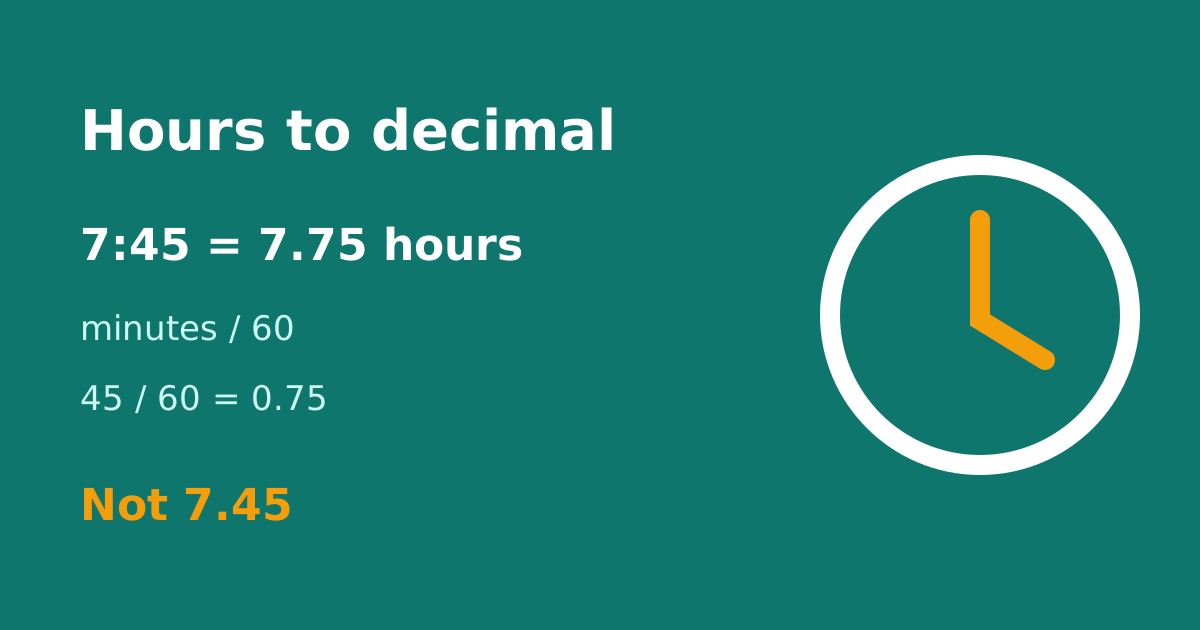
Decimal hours turn hours and minutes into one number you can multiply by a pay rate. The method is short. Divide the minutes by 60, then add the whole hours. So 7 hours 45 minutes becomes 7.75 hours. One wrong digit changes a paycheck, so this guide shows the math and the traps.
The Work Hours Calculator shows every total in both hh:mm and decimal form, so you can check each example.
Why Payroll Uses Decimal Hours
Payroll systems multiply hours by a wage. You cannot multiply 7:45 by $18 on a calculator, but you can multiply 7.75 by $18 and get $139.50. Clock time counts in 60s, while decimals count in 10s. That mismatch is the root of every conversion mistake.
The Formula
Decimal hours = Whole hours + (Minutes ÷ 60)
Take 6 hours 24 minutes. 24 ÷ 60 is 0.40, so the total is 6.40 hours. For 3 hours 10 minutes, 10 ÷ 60 is 0.1667. Round to two places and you get 3.17 hours. The whole hours never change. Only the minutes need converting.
Minutes to Decimal Chart
| Minutes | Decimal | Minutes | Decimal |
|---|---|---|---|
| 5 | 0.08 | 35 | 0.58 |
| 10 | 0.17 | 40 | 0.67 |
| 15 | 0.25 | 45 | 0.75 |
| 20 | 0.33 | 50 | 0.83 |
| 25 | 0.42 | 55 | 0.92 |
| 30 | 0.50 | 60 | 1.00 |
Each minute is worth about 0.0167 hours. That helps with odd values such as 17 or 38 minutes. Divide by 60 for the exact answer.
Example: One Shift
You clock in at 8:10 am and out at 4:00 pm with a 30 minute lunch. The gap is 7 hours 50 minutes. Subtract lunch and you worked 7 hours 20 minutes. 20 ÷ 60 is 0.33, so the total is 7.33 hours. At $18 an hour, that pays $131.94. The exact value, 7.3333, pays $132.00. The six-cent gap comes from rounding, which the next sections explain.
Example: A Full Week
Convert the weekly total once, not each day. Say your days are 8:15, 7:50, 8:30, 6:45, and 7:20. The hours add to 36. The minutes add to 160, which is 2 hours 40 minutes. The week is 38 hours 40 minutes. Convert 40 ÷ 60 to get 0.67, so the total is 38.67 hours. At $22 an hour, gross pay is $850.74. Converting each day first and adding the rounded values can drift by a few cents.
Decimal Back to Minutes
Multiply the decimal part by 60. For 6.40 hours, 0.40 x 60 is 24, so the time is 6 hours 24 minutes. For 2.85 hours, 0.85 x 60 is 51 minutes.
Why Rounding Creates Small Errors
Many fractions never end. Twenty minutes is 0.3333 and so on. Payroll must cut the number somewhere, and two decimals is common. Three 20 minute tasks then convert to 0.33 each, which adds to 0.99. Yet they make exactly one hour. One cent is nothing, but across many workers and pay periods the choice matters.
Some systems keep four decimals during the math and round only the final pay. That gives the most exact result. Others use tenths of an hour, where each step is 6 minutes. Then 12 minutes is 0.2 and 18 minutes is 0.3. It is simple, but it can shift a total by up to 3 minutes per entry. Rounding rules for punches are a separate topic, covered in the 7 minute rule guide.
Mental Math Shortcuts
Learn the quarter hours first. 15 minutes is 0.25, 30 is 0.50, and 45 is 0.75. Then remember that 6 minutes is 0.1, so you can count in sixes. 12 minutes is 0.2, 24 is 0.4, and 36 is 0.6. For odd values, start at a friendly number and adjust. 28 minutes is 2 short of 30, so it is about 0.50 minus 0.03, or 0.47. The exact value is 0.4667.
Converting in Excel and Google Sheets
Spreadsheets store time as a fraction of a day. Noon is 0.5. To get decimal hours, multiply a time value by 24. If cell A1 holds 7:45, then =A1*24 returns 7.75. Format that cell as a number, or you will see a clock value again.
For the gap between a start in A1 and an end in B1, use =(B1-A1)*24. For overnight shifts, use =MOD(B1-A1,1)*24, which handles both cases. When you add a column that passes 24 hours, format the total as [h]:mm. Without the brackets, a 38:40 week shows as 14:40.
Common Mistakes
The biggest mistake is writing 7:45 as 7.45. The digits after the point are hundredths, not minutes, so 7.45 really means 7 hours 27 minutes. At $20 an hour, 7.45 pays $149.00 while 7.75 pays $155.00. The worker loses $6 in one day.
The second mistake is converting before you subtract breaks. Subtract in clock time first, then convert. The third is rounding too early. Keep extra digits until the last step. The fourth is confusing decimal time with military time. A value like 13:30 is a time of day, while 13.50 is a length of time.
Other Names for Decimal Hours
You may see the same idea called industrial time, time card decimals, or hundredths of an hour. Some factory clocks use tenths of an hour, and others use hundredths. Ask which one your employer uses, because it decides how your minutes round.
Decimals for Freelancers and Billing
Freelancers use the same math on invoices. Suppose you spend 3 hours 42 minutes on a project. 42 ÷ 60 is 0.70, so you bill 3.70 hours. At $60 an hour, the line item is $222.00. Some agencies bill in tenths of an hour, where each 6 minute step counts as 0.1. Round up to the next tenth only if your contract says so.
Decimals With Overtime
Decimals make overtime easy. Take 44 hours 30 minutes, or 44.50 hours, at $20 an hour. The first 40 hours pay $800. The other 4.50 hours pay at $30, which adds $135. Gross pay is $935. The overtime pay guide covers bonuses and other special cases.
Show Both Formats
Clock time suits people who read schedules. Decimals suit people who check pay. A good time card prints both, so a worker can verify the hours and a payroll clerk can verify the money. That is why the calculator on this site shows hh:mm next to decimal hours. For adding a full week first, read how to calculate work hours.
Related Guides
- How to Calculate Work Hours in a Week. Start here if you still need to total a full week.
- Common Time Card Mistakes and How to Fix Them. See what the 7:45 vs. 7.45 error costs and how to spot it.
- How Overtime Pay Is Calculated. Use decimal hours to work out regular and overtime pay.
Want to test your own week? Open the work hours calculator, or see all payroll time guides.
Sources
This guide is general information, not legal advice. Rules vary by state and job type, so check your state labor office too.