 Work Hours Calculator
Weekly vs. Daily Overtime
How each rule works, which states use daily limits, and how to avoid counting an hour twice. Published June 18, 2026. Updated October 23, 2026.
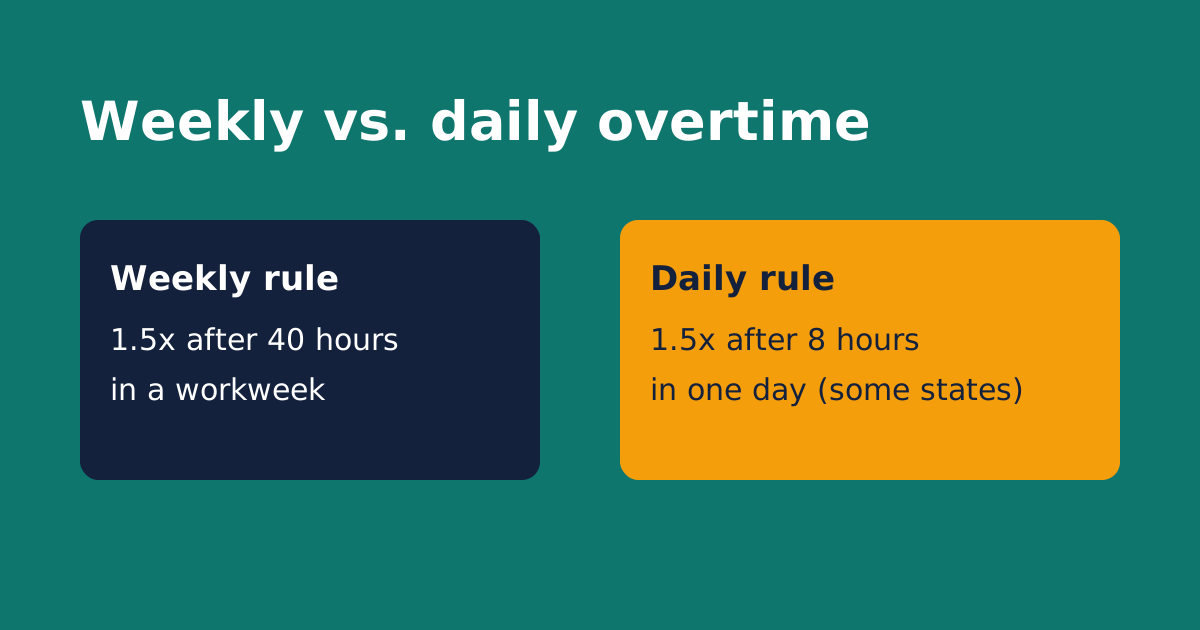
Weekly overtime starts after 40 hours in a workweek. Daily overtime starts after a set number of hours in one day. Federal law uses the weekly rule. A few states, including California, Alaska, Nevada, and Colorado, add daily limits. The difference can change a paycheck by hundreds of dollars a month, even when total hours stay the same.
This guide compares the two rules, shows how they work together, and explains how to set up the Work Hours Calculator for either one.
The Workweek
Overtime depends on the workweek, so start there. Under federal rules, a workweek is a fixed, repeating period of 168 hours, or seven straight 24 hour days. It does not have to match the calendar week. An employer can start it on Wednesday at noon. It should stay the same over time, and hours cannot be averaged across two weeks. If you work 50 hours one week and 30 the next, you still earned overtime for the first week.
The Weekly Rule
The Fair Labor Standards Act requires at least 1.5 times the regular rate for each hour over 40 in a workweek. How the hours are spread does not matter. Four 10 hour days make 40 hours, so no federal overtime is due. Six 8 hour days make 48, so 8 hours earn overtime.
The Daily Rule
Daily overtime looks at each day alone. Once you pass the daily limit, the extra hours pay more. With overtime after 8 hours, a 10 hour day has 8 regular hours and 2 overtime hours. What you worked on other days does not matter. Daily rules come from state law, union contracts, and some company policies. A promise in a handbook or offer letter can be binding, so look for phrases like “overtime after 8 hours.”
States With Daily Overtime
| State | General daily rule |
|---|---|
| California | 1.5x after 8 hours a day, 2x after 12 hours a day, and special pay on the seventh day in a row |
| Alaska | 1.5x after 8 hours a day for most private employers |
| Nevada | 1.5x after 8 hours a day for workers who earn less than 1.5 times the state minimum wage, with exceptions for some agreed schedules |
| Colorado | 1.5x after 12 hours in a day or 12 hours in a row, plus the weekly rule |
Other states have narrower rules, such as seventh-day pay or industry limits. State law changes, so confirm the current rule with your state labor department. When state and federal rules both apply, the worker gets the one that pays more.
How the Two Rules Work Together
The same hour cannot earn overtime twice. This is called the no-pyramiding principle. Payroll finds daily overtime first. It then adds the remaining regular hours for the week. Only the regular hours above 40 earn extra weekly overtime. Think of two filters. The daily filter pulls out hours past the daily limit. The weekly filter checks what is left.
Side-by-Side Examples
These four schedules use $20 an hour, daily overtime after 8 hours, and weekly overtime after 40.
| Schedule | Total hours | OT hours, weekly only | OT hours, daily and weekly | Pay, weekly only | Pay, daily and weekly |
|---|---|---|---|---|---|
| Four 10 hour days | 40 | 0 | 8 | $800 | $880 |
| Five 9 hour days | 45 | 5 | 5 | $950 | $950 |
| Three 12 hour days | 36 | 0 | 12 | $720 | $840 |
| One 12 hour day, four 8 hour days | 44 | 4 | 4 | $920 | $920 |
The first row says the most. Four 10 hour days total exactly 40 hours, so a federal-only employer owes no overtime. In a daily overtime state, each day has 2 overtime hours, which adds $80 to the check. Rows two and four show no-pyramiding at work. The regular hours never pass 40, so no second layer applies.
Check It by Hand
- Write your paid hours for each day, after unpaid breaks.
- Mark hours over the daily limit as overtime.
- Add the remaining regular hours across the week.
- Move any regular hours above 40 into overtime.
- Pay regular hours at your rate and overtime hours at 1.5 times your rate.
Take 10, 10, 9, 8, and 4 hours at $24 an hour. Daily overtime is 2 + 2 + 1, or 5 hours. Regular hours are 8 + 8 + 8 + 8 + 4, or 36, which is under 40. Pay is 36 x $24, or $864, plus 5 x $36, or $180. Gross pay is $1,044.
California in More Detail
California has the most layers. After 8 hours in a day, pay rises to 1.5 times. After 12 hours, it rises to 2 times. On the seventh straight day of work in a workweek, the first 8 hours pay 1.5 times and later hours pay double. Take a worker at $22 an hour who works 13 hours in one day. The first 8 hours pay $176. Hours 9 through 12 pay $33 each, or $132. The 13th hour pays $44. The day totals $352.
Compressed Schedules
A four-day, 10 hour week is popular because it gives a three-day weekend. Under federal law it works fine, since 40 hours is the limit. In a daily overtime state, it triggers overtime unless an exception applies. California allows an alternative workweek if two-thirds of a work unit votes for it in a secret ballot. Nevada allows agreed four-day schedules in some cases. Before you accept longer days, ask how overtime will work.
Overnight and Split Shifts
Daily rules raise a puzzle for night work. Does the daily limit count calendar days or 24 hour periods? Laws differ, and many states define the day as 24 hours from when the workweek starts. The overnight shift guide shows how to log hours that cross midnight. Split shifts follow the same idea. Add all hours worked in the day, even if you left for a few hours between shifts. Unpaid breaks come out first, as the breaks guide explains.
Exempt Employees
Exempt employees do not earn overtime under either rule. Pay level and duties decide who is exempt, and job title does not. California uses its own salary and duty tests, which are stricter than the federal ones. If you are salaried and work long days, check your status before you assume you are exempt.
Three Real-World Scenarios
A restaurant server picks up a 14 hour Saturday double. In a federal-only state, those hours matter only for the weekly total. In a daily overtime state, the 6 hours past the 8 hour mark pay more, even if the server works just three days that week.
A warehouse worker puts in 11 hours on a busy Monday, then short days, for a weekly total of 38. The weekly rule owes nothing. A daily rule owes 3 overtime hours for Monday.
A nurse works three 12 hour shifts and one 4 hour shift. The weekly total is 40, so federal overtime does not apply. Under an 8 hour daily rule, each 12 hour shift has 4 overtime hours, or 12 in all.
Set Up the Calculator
Enter start, end, and break for each day. Choose the overtime rule from the menu. Weekly uses the 40 hour limit, and Daily uses the daily limit. Daily and weekly applies both without counting any hour twice. For a California-style setup, use 8 hours a day and 40 hours a week. The tool applies one multiplier to all overtime, so it cannot show California double time after 12 hours. For those days, figure the extra by hand.
Common Mistakes
Workers often average hours across days. Ten hours Monday and six Tuesday do not average to eight, because Monday still has two overtime hours. Another mistake is stacking daily and weekly overtime on the same hour. A third is forgetting that unpaid meal periods come out before you count daily hours. On the employer side, some apply only the weekly rule in a daily overtime state, or leave bonuses out of the regular rate. The overtime pay guide covers the regular rate and the full pay math.
Related Guides
- How Overtime Pay Is Calculated. Walk through the formula and the regular rate.
- Biweekly vs. Semimonthly Pay. See how pay periods affect when overtime shows up on your check.
- How to Calculate Overnight and Night Shift Hours. Learn how night shifts split across workdays.
Want to test your own week? Open the work hours calculator, or see all payroll time guides.
Sources
- U.S. Department of Labor overtime page
- Department of Labor state overtime page
- Department of Labor FLSA page
This guide is general information, not legal advice. Rules vary by state and job type, so check your state labor office too.