 Work Hours Calculator
Biweekly vs. Semimonthly Pay
How each pay schedule works, how to total hours for a period, and where overtime lands. Published February 26, 2026. Updated October 23, 2026.
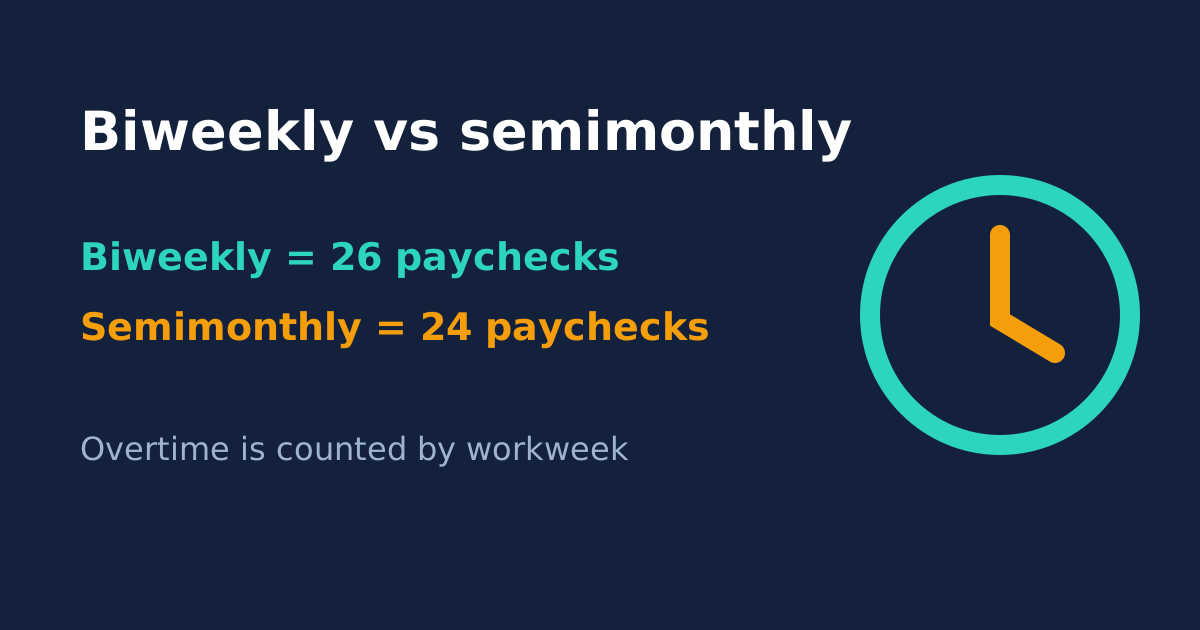
Biweekly pay means a paycheck every two weeks, and semimonthly pay means two paychecks each month. The names sound alike, but the schedules differ. Biweekly gives you 26 paychecks a year, and semimonthly gives you 24. That gap changes how you check hours, estimate pay, and plan bills.
This guide explains both schedules, shows how to total hours for a pay period, and says where overtime lands. You can total each workweek in the Work Hours Calculator and add the weeks.
Common Pay Frequencies
| Schedule | Paychecks per year | Hours behind each check (40 hour week) |
|---|---|---|
| Weekly | 52 | 40 |
| Biweekly | 26 | 80 |
| Semimonthly | 24 | About 86.67 |
| Monthly | 12 | About 173.33 |
A full-time worker logs about 2,080 hours a year, which is 40 hours times 52 weeks. Divide that by the number of paychecks to get the hours behind each one. That is how the table reaches 86.67 and 173.33.
How Biweekly Pay Works
A biweekly period covers 14 days and always holds two full workweeks. Paydays land on the same weekday, such as every other Friday. Hours are easy to total. Add week one to week two. The calendar adds a quirk. Twenty-six checks leave a day or two over, so most years have two months with three paychecks.
How Semimonthly Pay Works
Semimonthly periods follow the calendar. A common pattern is the 1st through the 15th, and the 16th through the end of the month. If a payday falls on a weekend, employers usually pay the Friday before. The periods are unequal. The first always has 15 days, and the second has 13 to 16. Workdays vary too. In November 2026, days 1 through 15 hold 10 weekdays, and days 16 through 30 hold 11. At 8 hours a day, that is 80 hours in the first period and 88 in the second.
Total Hours for a Biweekly Period
Total each workweek alone, apply overtime to each week, then add the weeks. Take a worker at $20 an hour. Week one has 44 hours and pays 40 x $20, or $800, plus 4 overtime hours at $30, or $120. That is $920. Week two has 36 hours and pays $720. The period total is $1,640.
Now see what averaging does. Treating both weeks as 40 hours pays 80 x $20, or $1,600. That is $40 too low. The law reads each workweek alone, so the overtime in week one stands. The weekly vs. daily overtime guide explains why.
Total Hours for a Semimonthly Period
The steps are the same, but the edges are messier. A pay period can split a workweek in half, with the first days in one period and the rest in the next. Overtime for a workweek is due on the payday for the period in which that workweek ends. Say a Monday-through-Sunday workweek crosses the 15th, a Wednesday. Hours worked Monday through Wednesday fall in the first period. The week ends Sunday the 19th, so its overtime shows up in the second period. Regular pay for those first three days still goes in the first check. Only the premium waits. When you check a stub, look at the whole workweek, not just the days inside the period. The overtime pay guide covers the payday rule in full.
Salary to Hourly, and Back
Divide annual pay by 2,080 to get an hourly equivalent for a 40 hour week. A $52,000 salary equals $25 an hour. Biweekly pay is $52,000 ÷ 26, or $2,000. Semimonthly pay is $52,000 ÷ 24, or $2,166.67. The yearly total is the same, and each semimonthly check is larger because there are fewer of them.
You can also work backward. A gross biweekly check of $1,840 divided by 80 hours gives $23 an hour. For a semimonthly check, divide by 86.67.
An Hourly Worker on Semimonthly Pay
Imagine $18.50 an hour and 8 hours a day, Monday to Friday. In the first half of November 2026, that is 80 hours and $1,480 gross. In the second half, it is 88 hours and $1,628. The second check is $148 higher with no raise and no overtime. A salaried worker gets the same check every time, but an hourly worker's checks rise and fall with the calendar.
Which Schedule Is Better
Neither wins in every case. Biweekly lines up with workweeks, so hours are easier to audit, and it creates two three-paycheck months. Semimonthly lines up with monthly bills, because each month holds exactly two checks. Many payroll teams prefer semimonthly for salaried staff and biweekly for hourly staff. That is a common practice, not a rule.
Federal law requires regular pay but sets no schedule. States do. California requires most employers to pay at least twice a month. New York requires weekly pay for manual workers in most cases. Check your state labor department if pay arrives later than promised.
Three-Paycheck Months
Say your first 2026 payday is Friday, January 2, with one every 14 days after. January gets three checks, on the 2nd, 16th, and 30th. July gets three, on the 3rd, 17th, and 31st. Every other month has two. Plan for those extra checks in advance.
Pay Period vs. Pay Date
The pay period is the time you worked. The pay date is the day the money arrives. Most employers pay a few days to a week after the period ends. A period that ends on a Friday might pay the next Friday. Ask for the pay calendar, which lists both dates for the whole year.
Budget From Your Lowest Check
Hourly checks change, so plan from the lowest expected one. At $23 an hour, 80 hours pay $1,840 gross. A period with only 72 hours pays $1,656. Pay fixed bills from the low number, and treat anything above it as extra for savings.
Check Your Pay With One Yearly Number
At $23 an hour for 2,080 hours, annual gross pay is $47,840. Over 26 biweekly checks, each is $1,840. Over 24 semimonthly checks, each is $1,993.33. If your checks fall far from that, look for missed hours, unpaid leave, or a rate change.
Checking a Pay Stub
Match the stub dates to the pay period. Match its hours to your own record. Check the rate on each line, then multiply and add. The result should equal gross pay. Convert each week to decimals before you add. If week one is 41:30 and week two is 38:45, write 41.50 and 38.75 for a period total of 80.25 hours. The decimal hours guide covers odd minutes.
Special Cases
Bonuses can land in a different period than the work that earned them. For overtime, the law spreads a bonus across the weeks it covers, which raises the regular rate in any week with overtime. Ask payroll how it handles this. Part-time workers can see big swings, such as 24 hours one week and 31 the next. The method stays the same. Total each week, apply the rate, and add. When a job ends, some states require final pay on the last day, and others allow the next regular payday. Total the final partial period with the same weekly method.
Common Mistakes
- Averaging two weeks to avoid overtime.
- Treating every semimonthly period as 80 hours.
- Assuming overtime always lands in the same check as the hours.
- Confusing the pay date with the end of the pay period.
- Comparing gross pay to take-home pay.
If a check comes up short, add up your own hours first and compare them with the stub. Then write to payroll with the dates and the gap. The calculator totals one workweek at a time, so run each week and add the results. Set the overtime rule to weekly, and use the CSV button to save each week. For help with each week, read how to calculate work hours.
Related Guides
- How Overtime Pay Is Calculated. Check how overtime is figured inside each workweek.
- Weekly vs. Daily Overtime. Compare the weekly and daily rules.
- How to Convert Hours and Minutes to Decimal Hours. Convert your period total to decimal hours.
Want to test your own week? Open the work hours calculator, or see all payroll time guides.
Sources
This guide is general information, not legal advice. Rules vary by state and job type, so check your state labor office too.