 Work Hours Calculator
How Overtime Pay Is Calculated
The formula, the regular rate, and the examples that change your check. Published July 17, 2026. Updated October 23, 2026.
Overtime pay is extra pay for hours beyond a set limit. Under federal law, most hourly workers earn at least 1.5 times their regular rate after 40 hours in a workweek. The idea is simple. The details trip people up, especially with bonuses, two pay rates, and state rules.
This guide does the basic math first, then the harder cases. The Work Hours Calculator can check each example.
The 40 Hour Rule
The Fair Labor Standards Act, or FLSA, is the federal law behind overtime. It requires covered employers to pay non-exempt employees at least one and one-half times their regular rate for every hour over 40 in a workweek. Each week stands alone. You cannot average two weeks together, so 50 hours in week one and 30 in week two still earns 10 overtime hours. The weekly vs. daily overtime guide defines the workweek.
Who Gets Overtime
Non-exempt employees get overtime, and exempt employees do not. Duties and pay decide which one you are. Your job title does not. To be exempt in most office jobs, you must earn at least $684 a week ($35,568 a year) on a salary basis and do executive, administrative, or professional work. That level was $455 a week until 2020. A 2024 increase was struck down by a federal court, and the Department of Labor restored the $684 figure in 2026. Some states set a higher bar, so check yours.
A salary alone does not make you exempt. Many salaried workers still earn overtime.
The Basic Formula
Overtime pay = Overtime hours x Hourly rate x 1.5
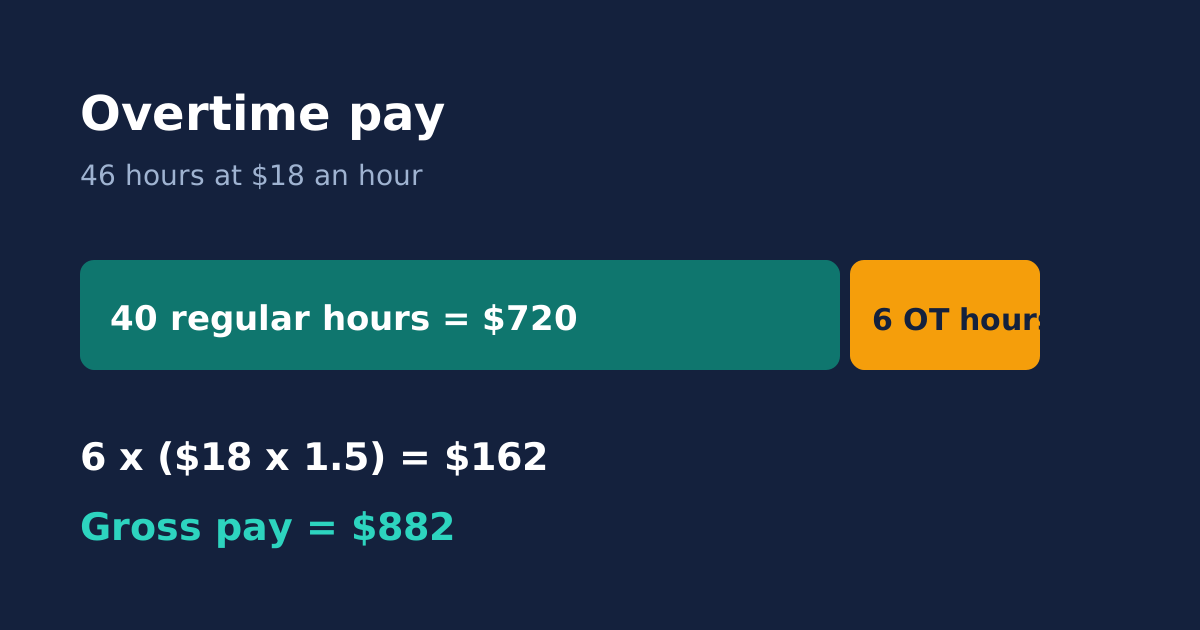
Say you earn $18 an hour and work 46 hours. Your first 40 hours pay $720. The 6 overtime hours pay $27 each, or $162. Gross pay is $882. Overtime applies only to the extra hours, and the first 40 stay at the regular rate.
What Counts as the Regular Rate
The regular rate is not always your base wage. It is your total pay for the week from all sources, divided by hours worked. That matters when you earn extras.
These items usually go into it.
- Night or weekend shift differentials.
- Production and attendance bonuses promised in advance.
- Commissions.
- The cash value of meals or housing the employer provides.
These usually stay out.
- Discretionary bonuses, where the employer picks the amount and timing at the end.
- Holiday gifts and expense reimbursements.
- Pay for time not worked, such as vacation or sick leave.
- Premium pay for hours over a daily or weekly limit.
Example: A Bonus in the Mix
You earn $20 an hour, work 45 hours, and earn a $200 attendance bonus promised in advance. Straight-time pay is 45 x $20, or $900. Add the bonus for $1,100, and divide by 45 hours. Your regular rate is $24.44. Straight time already covers every hour, so the employer owes only the extra half for 5 hours. That is 5 x $12.22, or $61.11. Gross pay is $1,161.11. Skipping the bonus rule would shortchange you by about $11.
Example: Two Pay Rates
Suppose you work 30 hours at $16 and 14 hours at $20. That is 44 hours and $760 in straight-time pay. Divide $760 by 44 for a regular rate of $17.27. The half-time premium for 4 overtime hours is $34.55, so gross pay is $794.55. An employer may use the rate of the job you were doing when overtime began, but only if you agreed in advance.
Example: Salaried and Piece-Rate Workers
A non-exempt employee paid $1,000 for a 40 hour week has a regular rate of $25. After 45 hours, overtime is 5 x $37.50, or $187.50, and gross pay is $1,187.50. A method called the fluctuating workweek is allowed in some cases. It needs a clear agreement and is banned in some states.
Piece-rate pay works too. Divide total earnings by total hours. If you earn $900 over 45 hours, your regular rate is $20. You already received straight time for every hour, so each of the 5 overtime hours adds a $10 premium. The total is $950.
Double Time and Comp Time
Double time pays 2 times the regular rate. The FLSA does not require it. Some states, such as California, do in specific cases, and union contracts often use it for holidays. At $22 an hour, double time is $44.
Comp time means time off in place of cash. Private employers cannot swap it for overtime pay. Government agencies can, within limits. Public employees can bank 240 hours, or 480 for public safety and seasonal workers. Each overtime hour earns 1.5 hours of comp time.
Healthcare and the 8 and 80 System
Hospitals and residential care facilities may use an 8 and 80 system if employees agree in advance. Overtime applies after 8 hours in a day and after 80 hours in a 14-day period. The employer must pay whichever rule gives the higher total, so long shifts do not cost nurses and aides pay.
Paid Time Off and Holidays
Paid time off does not count toward the 40 hour line under federal law. A worker with 36 hours worked and 8 hours of vacation has 44 paid hours but only 36 worked, so no overtime is owed. Holiday pay works the same way unless a contract says otherwise. Hours you work on a holiday count like any other.
When Overtime Must Be Paid
Overtime belongs on the regular payday for the pay period when the work happened. If the employer cannot figure the amount by then, it must pay as soon as it can, and no later than the next payday. A late check can still be a violation.
Taxes on Overtime
Overtime is taxed like any other wages. A big check can look like it loses more to tax. That happens because payroll systems estimate yearly income from one pay period. Your actual tax is settled when you file, and you may get part of it back.
When Overtime Is Not Paid
Unpaid overtime is one of the most common wage complaints. It happens when employees work off the clock, when auto-deducted breaks are not taken, or when a worker is wrongly labeled exempt. Keep your own log and save any messages that show you were asked to work extra.
Ask payroll to review the record first. If that fails, contact the Wage and Hour Division of the Department of Labor or your state labor office. Federal claims generally have a two-year limit, or three years for willful violations. Employers who break the law may owe back pay and an equal amount in damages.
Check Your Overtime on a Paycheck
Find the hours worked on your stub, and compare them with your own record. Check the rate shown for overtime hours. It should be at least 1.5 times your regular rate, and the regular rate should include any qualifying bonus. Then add the lines. Regular hours times the regular rate, plus overtime hours times the overtime rate, should equal gross pay.
The calculator uses one multiplier for all overtime hours and does not handle bonuses. If you have a bonus, find your regular rate by hand first. Then enter it as the hourly rate.
Common Mistakes
Workers often use the base wage when a bonus or differential should raise the regular rate. They also count vacation hours toward the 40 hour line. Employers slip too. Some round time in a way that always favors the company. Others move hours between weeks to keep each week under 40, which breaks the rules because every workweek stands alone. If a check looks off, check these points first. Then read how to calculate work hours to confirm the hours are right.
Related Guides
- Weekly vs. Daily Overtime. Find out whether your overtime is counted by the week, the day, or both.
- Biweekly vs. Semimonthly Pay. See how your pay schedule changes where overtime lands.
- How to Convert Hours and Minutes to Decimal Hours. Convert your hours before you multiply by your rate.
Want to test your own week? Open the work hours calculator, or see all payroll time guides.
Sources
- U.S. Department of Labor overtime page
- Department of Labor FLSA page
- Department of Labor fact sheet on hours worked
This guide is general information, not legal advice. Rules vary by state and job type, so check your state labor office too.