 Work Hours Calculator
The 7 Minute Rule and Payroll Time Rounding
How quarter hour rounding works, when it is fair, and how to check your own time card. Published July 31, 2026. Updated October 23, 2026.
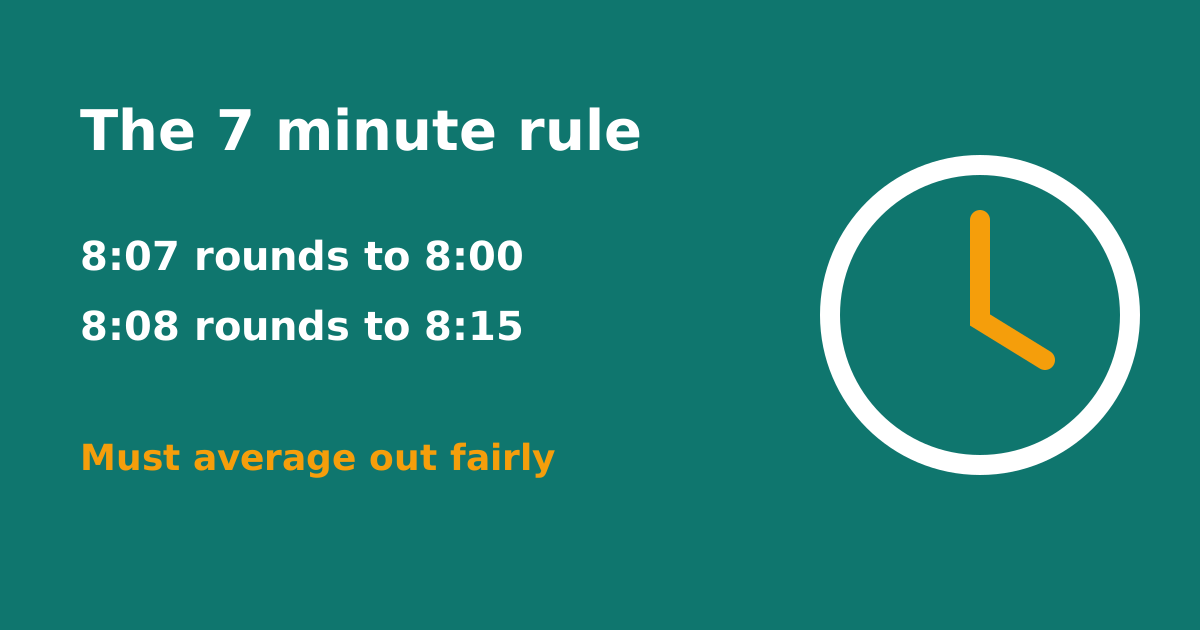
The 7 minute rule is a payroll method that rounds clock punches to the nearest quarter hour. A punch within 7 minutes after a quarter mark rounds down. A punch 8 minutes or more past it rounds up. Many employers use it because it keeps time cards neat. It is legal under federal rules, but only when it works fairly for workers.
This guide shows how the rule works, when rounding turns unlawful, and how to test your own time card. The rounding menu in the Work Hours Calculator lets you try it.
What the Rule Means
An hour has four quarter marks, at :00, :15, :30, and :45. Each punch lands on the closest one. The halfway point between two marks is 7.5 minutes, so the line falls between 7 and 8. A clock-in at 8:07 rounds down to 8:00. A clock-in at 8:08 rounds up to 8:15. Clock-out times follow the same logic.
No law carries that name. The rule comes from a federal regulation that allows rounding to the nearest quarter hour. The 7 minute label is just the common shorthand.
| Punch falls between | Rounds to |
|---|---|
| 8:00 to 8:07 | 8:00 |
| 8:08 to 8:22 | 8:15 |
| 8:23 to 8:37 | 8:30 |
| 8:38 to 8:52 | 8:45 |
| 8:53 to 9:07 | 9:00 |
The Federal Rule Behind It
The Department of Labor regulation at 29 CFR 785.48 allows rounding to the nearest 5 minutes, one-tenth of an hour, or quarter hour. The catch is that the practice must average out, so employees are fully paid for all the time they work. That is the legal test. The method itself is not the problem. What matters is whether the result favors the employer every time. Rounding that sometimes helps you and sometimes helps the company is fine. Rounding that only hurts you is not.
Other Rounding Methods
Some employers round to the nearest 5 minutes. Then 8:02 rounds to 8:00 and 8:03 rounds to 8:05. Others round to a tenth of an hour, or 6 minutes. That suits decimal pay, and 8:02 rounds to 8:00 while 8:03 rounds to 8:06. Smaller blocks stay closer to the truth. A 5 minute block shifts a punch by at most 2.5 minutes, and a quarter hour shifts it by up to 7.5. All three options are in the calculator.
A Week With the Rule
Rounding can help and hurt in the same week. Look at three days from one worker.
| Day | Punches | Exact time | Rounded | Rounded time |
|---|---|---|---|---|
| Mon | 7:58 am to 5:03 pm | 9:05 | 8:00 to 5:00 | 9:00 |
| Tue | 8:06 am to 5:10 pm | 9:04 | 8:00 to 5:15 | 9:15 |
| Wed | 7:52 am to 4:58 pm | 9:06 | 7:45 to 5:00 | 9:15 |
The exact total is 27 hours 15 minutes. The rounded total is 27 hours 30 minutes. Monday cost the worker 5 minutes. Tuesday gave back 11, and Wednesday gave back 9. The worker nets 15 extra minutes. That is what a fair system looks like, because gains and losses balance over time.
When Rounding Becomes Illegal
Rounding turns unlawful when it consistently takes pay from employees. A clear case is a system that always rounds clock-ins to the later quarter hour and clock-outs to the earlier one. It trims time from every shift and can never help the worker.
Another case looks neutral on paper. A store tells staff to clock in a few minutes early, and its system rounds those punches up to the scheduled start. If employees work during those minutes, the rounding erases paid time.
Courts compare rounded hours to actual hours over many pay periods. If workers lose time overall, the employer may owe back pay. Federal claims can reach back two years, or three for willful violations, with an equal amount in damages.
What Five Minutes a Day Costs
Take a worker who loses 5 minutes a day over 250 shifts. That is 1,250 minutes, or about 20.8 hours. At $20 an hour, the loss is $416.67 a year. For a team of 100, it passes $41,000.
Early Punches and Time Before the Shift
Hours worked include only time on duty. If you punch in at 7:50 and sit at a break table until your 8:00 start, that time is generally not work time, as long as you are free to leave. The picture changes if you start working at 7:50. Opening the register, answering phones, or putting on required safety gear all count. Then rounding the punch to 8:00 cuts paid time. When duties begin early, make sure the card shows it.
Meal Periods and Grace Periods
Rounding gets stricter around meals. In 2021, the California Supreme Court ruled that employers cannot round meal period punches, because rounding can hide a short or late break. Other states have their own rules. Check yours if your employer rounds lunch punches.
A grace period is different. It lets you punch in a few minutes late without a penalty. That is a scheduling policy, not a pay rule. If you start at 8:04 on an 8:00 shift, the employer still owes pay from 8:04 on.
Rounding Punches vs. Rounding Totals
Rounding can apply to each punch or to the final total. The usual 7 minute rule rounds each punch. Rounding totals means you add exact times and round once. A day with four punches can shift by up to 30 minutes in the worst case when every punch rounds. Rounding only the final total shifts it by at most 7.5 minutes. Where employers have a choice, rounding totals leaves less room for error.
How Rounding Affects Overtime
Rounding can move a week across the 40 hour line. An exact total of 40 hours 5 minutes may round to 40 flat, and the 5 minutes of overtime vanish. A week of 39 hours 55 minutes may round up to 40 and gain nothing extra. The effect is small, but overtime pays 1.5 times your rate, so lost minutes near the line cost more.
How to Check Your Own Time Card
- Write down your exact punches each day, or photograph the clock.
- Add the exact hours in hours and minutes.
- Apply your employer's rounding rule to each punch, and add those totals.
- Compare the two results over several weeks.
One week proves little, because luck plays a part. Look at a full month. Say the gap was plus 15 minutes in week one, minus 10 in week two, plus 5 in week three, and minus 20 in week four. The month nets to minus 10 minutes on about 160 hours. That is a tiny gap that can swing either way next month. A steady loss of 10 minutes every week would tell a different story.
The calculator makes this test fast. Enter your exact punches with rounding off, and note the total. Switch the menu to 15 minutes and compare. The difference is what the rule changes.
Why Employers Round, and What to Ask
Older time clocks printed only quarter hours, so rounding matched the equipment. Rounding also gives managers neat numbers. Modern software can track and pay exact minutes with little extra work. In my view, that makes the old reasons weaker today, but the law still allows fair rounding.
Digital clocks record punches to the minute, and rounding happens later in payroll software. So the raw data still exists. These questions can clear up most doubts.
- Do you round punches, and to what interval?
- Is the rule written in the handbook?
- Are meal punches rounded or paid exactly?
- Can I see a report that compares exact time to rounded time?
If Rounding Costs You Pay
Collect your own records for four to eight weeks. Compare exact time to paid time, and add up the gap. Show the numbers to your manager or HR in writing, and ask for a review. The time card mistakes guide explains how to escalate if nothing changes. Employers who want to avoid this risk can pick one interval, write it down, and run a quarterly exact-versus-rounded report. If it leans against workers, switching to exact minutes is the safest fix.
Related Guides
- Common Time Card Mistakes and How to Fix Them. Spot rounding and punch errors that quietly shorten your pay.
- Paid vs. Unpaid Breaks. Learn how break rules interact with rounded punches.
- How to Convert Hours and Minutes to Decimal Hours. Turn rounded times into decimal hours for payroll.
Want to test your own week? Open the work hours calculator, or see all payroll time guides.
Sources
This guide is general information, not legal advice. Rules vary by state and job type, so check your state labor office too.